
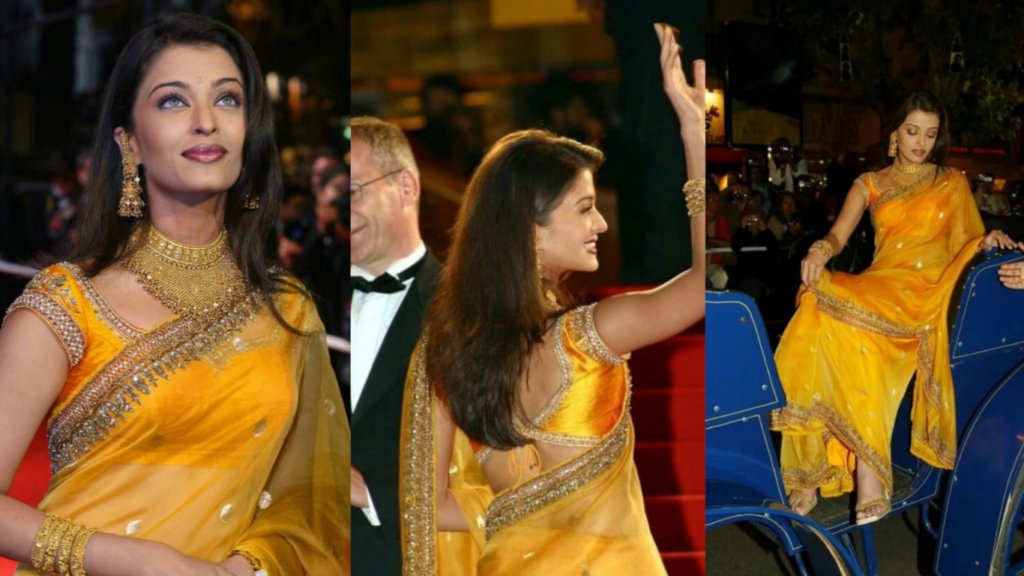
There are red carpet moments, and then there are moments that quietly rewrite fashion history. The aishwarya rai gold saree appearance at the Cannes Film Festival in 2002 wasn’t just another celebrity outfit—it was a statement, whether people were ready for it or not.
At a time when global red carpets were dominated by predictable gowns, this look stood out in a way that felt both bold and deeply rooted in identity. It wasn’t trying to blend in. It wasn’t trying to impress in the usual way. And maybe that’s exactly why it still gets talked about.
The Cannes 2002 Context: Why This Look Mattered
In 2002, Indian representation at Cannes wasn’t what it is today. The idea of showing up in traditional attire—especially something as culturally specific as a saree—wasn’t the obvious choice.
That’s what makes the aishwarya rai gold saree moment so interesting. It didn’t follow the global red carpet formula. Instead, it introduced something different, something unapologetically Indian.
Was it risky? Absolutely. But safe fashion rarely becomes iconic.
Breaking Down the Aishwarya Rai Gold Saree Look

Let’s actually look at what made this outfit stand out.
1. The Saree
The gold saree itself wasn’t subtle. It had a rich, almost theatrical shine, paired with intricate detailing that demanded attention. This wasn’t minimal elegance—it was maximal presence.
2. The Blouse
The heavily embroidered blouse added another layer of intensity. It leaned heavily into traditional Indian bridal aesthetics, which made the look even more distinct on an international carpet.
3. The Makeup and Styling
Bold makeup, defined eyes, and statement jewelry completed the look. Everything was coordinated, but not restrained. It was a full commitment to a vision.
A Hot Take: Was It Overdone?
Let’s be honest for a second. Not everyone loved it.
Some critics felt the look was too heavy, too ornate, even “costume-like.” And honestly? That criticism wasn’t entirely baseless. The aishwarya rai gold saree styling wasn’t minimal or understated by any means.
But here’s the thing—minimalism isn’t the only form of elegance.
Sometimes, fashion that feels excessive in the moment ends up becoming iconic precisely because it refuses to tone itself down.
Why the Aishwarya Rai Gold Saree Still Gets Attention Today
Fashion moves fast, but certain looks stay relevant for reasons beyond trends.
The aishwarya rai gold saree is remembered because:
- It challenged red carpet norms
- It represented Indian fashion globally
- It sparked conversation (and still does)
- It wasn’t trying to please everyone
And in today’s fashion landscape, where individuality is valued more than ever, that approach feels surprisingly current.
Saree on the Global Stage: A Turning Point
After 2002, the presence of sarees at international events became more frequent and more accepted.
While it would be unfair to credit one look entirely, the aishwarya rai gold saree undeniably played a role in shifting perceptions. It showed that traditional wear could exist on the same stage as couture gowns.
Not as an alternative—but as an equal.
Styling Lessons You Can Take from This Look
You don’t need a Cannes invitation to learn something from this.
1. Own Your Style Completely
Half-committed looks rarely work. This outfit worked because it was fully intentional. Every element—from the saree to the blouse to the jewelry—followed the same vision.
When you try to mix too many ideas or second-guess your styling, it shows. The real takeaway here is confidence in execution. If you choose a bold look, commit to it fully instead of diluting it halfway.
2. Don’t Always Play Safe
Sometimes, standing out matters more than fitting in. Red carpets are full of “safe” outfits that no one remembers the next day.
The aishwarya rai gold saree didn’t try to blend into global fashion norms, and that’s exactly why it stood out. Playing safe might avoid criticism, but it also avoids impact. If you want your look to be memorable, a little risk is necessary.
3. Cultural Fashion Has Power
Traditional pieces aren’t outdated—they’re underutilized. The saree, in this case, wasn’t just clothing. It was representation.
Wearing cultural fashion on a global stage adds depth to your style. It tells a story. And more importantly, it challenges the idea that only Western silhouettes belong in high-fashion spaces.
4. Balance Is Subjective
What feels “too much” to one person might feel iconic to another. Fashion doesn’t come with universal rules, no matter how many guides say otherwise.
The aishwarya rai gold saree look was called excessive by some and unforgettable by others. That difference in opinion is proof that balance isn’t fixed—it depends on perspective, context, and personal taste.
Recreating the Aishwarya Rai Gold Saree Vibe Today
If you’re inspired by this look, you don’t have to copy it exactly. In fact, you probably shouldn’t.
Instead:
- Choose a gold-toned saree with modern draping
- Pair it with a slightly simpler blouse
- Keep jewelry intentional, not excessive
- Let one element be the focus
The idea is to capture the confidence of the aishwarya rai gold saree look, not just the aesthetics.
Common Mistakes to Avoid
Trying to recreate iconic looks can go wrong quickly.
- Overloading with heavy accessories
- Ignoring fabric quality
- Choosing the wrong shade of gold for your skin tone
- Mixing too many traditional elements at once
The difference between elegant and overwhelming is often just one extra detail.
The aishwarya rai gold saree moment at Cannes 2002 wasn’t perfect, polished, or universally loved—and that’s exactly why it worked.
It challenged expectations, sparked debate, and most importantly, made people pay attention. In a world full of carefully curated red carpet looks, that kind of authenticity stands out.
And maybe that’s the real takeaway. Fashion doesn’t always need to be safe to be remembered.